
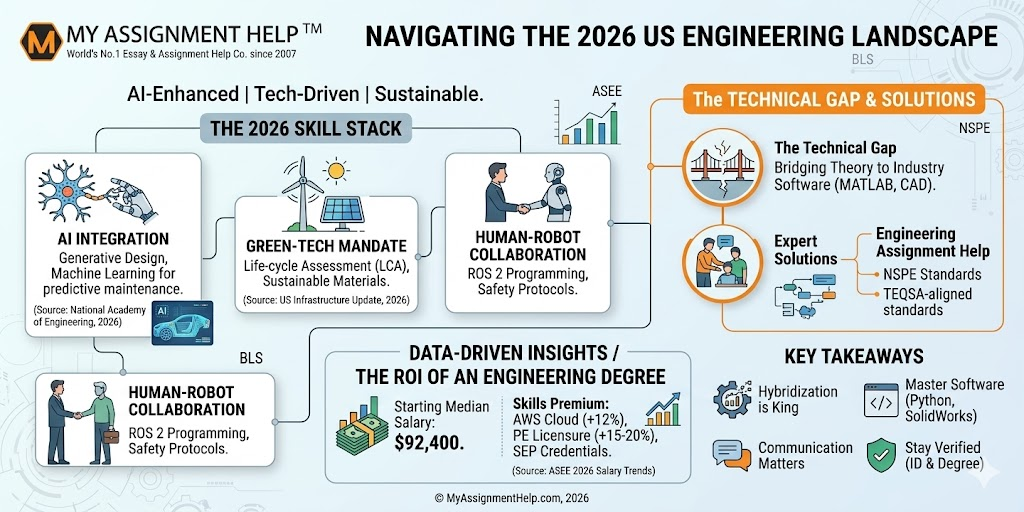
Navigating the 2026 Engineering Landscape: Essential Skills for US Grads
The American engineering sector in 2026 is no longer defined solely by traditional mechanics or civil infrastructure. As we cross the midpoint of the decade, the integration of Artificial Intelligence (AI), sustainable “Green-Tech,” and advanced robotics has fundamentally shifted the baseline for entry-level roles. For the Class of 2026, graduating from an ABET-accredited program is just the starting line; the race is won by those who can navigate the intersection of technical precision and digital fluency.
Recent data from the U.S. Bureau of Labor Statistics (BLS) suggests that while traditional engineering roles are growing at a steady 4–7%, specialized roles in Renewable Energy and AI Hardware are seeing a projected 24% surge through 2030. This shift requires graduates to be more than just “problem solvers”—they must be “systems thinkers” who understand the ethical and environmental implications of their designs.
As academic rigor reaches new heights to meet these industry demands, many students find that the transition from theory to complex project application is steeper than anticipated. Navigating these high-stakes requirements often necessitates strategic support; leveraging professional assignment writing help in the USA has become a common practice for high-achieving students who need to balance intensive lab work with the high-quality documentation required by modern rubrics.
The 2026 Engineering Skill Stack
1. Generative Design and AI Integration
In 2026, “AI-literacy” is a core competency. Engineering firms like SpaceX, Tesla, and GE are increasingly using generative design tools that utilize machine learning to optimize parts for weight, strength, and cost. Grads must be proficient in:
- Neural Network Frameworks: Understanding how to train models for predictive maintenance.
- AI-Enhanced CAD: Moving beyond 2D/3D modeling into AI-assisted structural optimization.
2. The Green-Tech Mandate
With the 2026 U.S. Infrastructure Update, sustainability is no longer an elective—it is a regulatory requirement. Whether you are a Civil or Electrical engineer, understanding the life-cycle assessment (LCA) of materials is vital. Knowledge of the Inflation Reduction Act’s long-term impacts on clean energy projects is now a frequently asked topic in Fortune 500 interviews.
3. Human-Robot Collaboration (HRC)
The manufacturing floor of 2026 features “Cobots” working alongside humans. Mechanical and Software engineers must understand the safety protocols and programming languages (like ROS 2) that govern these interactions.
Overcoming the “Technical Gap” in Higher Education
While US universities are updating curricula to match the 2026 TEQSA-aligned standards, students often face a “gap” between classroom theory and industry-grade software applications. Projects involving MATLAB simulations or complex structural analysis require a level of precision that goes beyond basic textbook knowledge.
For those struggling to translate complex datasets into high-scoring reports, seeking expert engineering assignment help provides a bridge. This specialized assistance ensures that technical designs are not only accurate but also presented with the professional clarity required by the National Society of Professional Engineers (NSPE) standards.
See also: How to Build a Successful Online Business from Scratch: A Step-by-Step Guide
Data-Driven Insights: The ROI of an Engineering Degree in 2026
According to Q1 2026 Salary Surveys, the starting median salary for US Engineering grads has reached $92,400. However, there is a distinct “skills premium” for those who hold certifications in:
- AWS/Azure Cloud Architecting: +12% salary increase.
- Professional Engineer (PE) Licensure: +15-20% long-term career growth.
- Sustainability Professional (SEP) Credentials: High demand in state-funded projects.
Key Takeaways for the Class of 2026
- Hybridization is King: Blend your core engineering discipline with data science or environmental policy.
- Master the Software: Proficiency in Python, SolidWorks (AI-version), and Revit is non-negotiable.
- Communication Matters: Being able to explain “The Why” behind a design to non-technical stakeholders is a top-three soft skill requested by US recruiters.
- Stay Verified: Ensure your academic output reflects the highest standards of integrity and “id and degree verified” expertise.
FAQ Section
Q1: Which engineering branch has the highest demand in the US for 2026?
Currently, Renewable Energy Engineering and Cyber-Physical Systems Engineering are seeing the highest year-over-year job posting growth due to federal investments in the “Smart Grid” and domestic semi-conductor manufacturing.
Q2: How important is AI knowledge for a Civil Engineer?
Crucial. Civil engineers in 2026 use AI for traffic flow modeling, structural health monitoring via IoT sensors, and carbon footprint predictions during the planning phase.
Q3: Can I get help with specific engineering software assignments?
Yes. Professional academic services now offer specialized support for software-heavy tasks including CAD, MATLAB, and LabVIEW to ensure students meet the technical benchmarks of modern universities.
About the Author
Dr. Sarah Jenkins, Senior Content Strategist at MyAssignmentHelp Dr. Jenkins is a Degree Verified academic consultant with over 12 years of experience in the US higher education sector. An advocate for E-E-A-T (Experience, Expertise, Authoritativeness, and Trustworthiness), she specializes in bridging the gap between academic theory and professional industry standards. Her work focuses on providing students with the analytical tools needed to succeed in competitive STEM environments. All her contributions are ID and Degree Verified to ensure the highest level of academic integrity.
References
- U.S. Bureau of Labor Statistics (2025-2026): Occupational Outlook Handbook: Architecture and Engineering.
- National Academy of Engineering (2026): The Impact of Generative AI on US Manufacturing.
- American Society for Engineering Education (ASEE): 2026 Annual Report on Engineering Salary Trends.